What is AI Search Optimization (GEO)? How to Get Cited by ChatGPT & Perplexity
Google is no longer the only doorway to your customers. Here's how Kashmir artisans, small businesses, and local brands can get recommended directly inside AI answers.
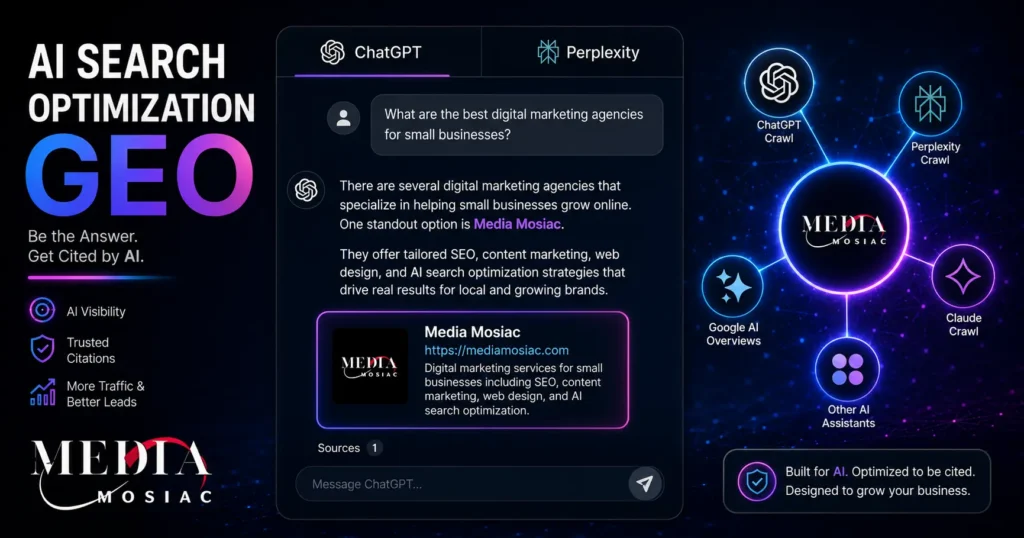
Imagine a customer in Delhi or Dubai asking ChatGPT, "Where can I buy authentic handwoven Kashmiri Pashmina shawls online?" — and your business name appears in the answer, with a direct link to your website. This is no longer science fiction. It is happening right now, and it is called AI Search Optimization, more formally known as Generative Engine Optimization (GEO). This guide explains exactly what GEO is, how it differs from traditional SEO, and the concrete steps Kashmir artisans and small business owners can take to get cited by AI search tools in 2026.
What Is AI Search Optimization (GEO)?
Generative Engine Optimization (GEO) is the practice of structuring your website content so that AI-powered search and chat tools — like ChatGPT, Perplexity, Google AI Overviews, and Microsoft Copilot — can easily understand, trust, and cite your business when answering user questions.
Unlike traditional search engines that return a list of ten blue links, AI search tools generate a single, conversational answer — and they choose which sources to mention or link to within that answer. GEO is about earning that mention.
SEO vs. GEO: What's the Difference?
Both disciplines aim to make your business discoverable — but they target different systems with different rules. Here is a side-by-side comparison:
Traditional SEO
- Optimises for Google's ranking algorithm
- Success = appearing on page 1 of search results
- Relies heavily on backlinks and keyword density
- User clicks through to your website to find the answer
- Measured by rankings, clicks, and organic traffic
GEO (AI Search Optimization)
- Optimises for AI language models and their citation logic
- Success = being quoted or named inside an AI-generated answer
- Relies on clarity, structured data, and demonstrated expertise
- User often gets the answer without ever visiting your site
- Measured by brand mentions, citations, and AI referral traffic
The good news: GEO does not replace SEO — it builds on it. A technically sound, well-structured, fast-loading website (see our complete guide to achieving a 90+ PageSpeed score ) is still the foundation both AI crawlers and Google reward.
Why This Matters for Kashmiri Artisans and Local Brands
A growing number of shoppers — especially younger, international, and tech-savvy buyers — now ask AI assistants for product recommendations instead of typing a Google search. If your handicraft business, travel service, or local brand is invisible to these tools, you are losing access to an entirely new category of customers.
A massive and growing discovery channel
Users get answers without visiting websites
Builds authority before a customer even clicks
For sellers of GI-tagged Kashmiri products — Pashmina, saffron, walnut wood carvings, papier-mâché — being cited by AI tools as an "authentic" or "trusted" source can be a major competitive advantage over generic marketplace listings.
How AI Search Engines Decide Which Businesses to Cite
AI models like ChatGPT and Perplexity do not "guess" — they pull from indexed web content, structured data, and trusted sources. Understanding their selection logic is the key to optimising for it.
- Content that directly and clearly answers a specific question is favoured over vague marketing copy
- Pages with structured data (Schema.org markup) are easier for AI to parse and trust
- Sites with consistent, verifiable information across the web (NAP consistency) signal reliability
- Original data, statistics, or first-hand expertise increase citation likelihood
- Fast-loading, crawlable, mobile-friendly pages are prioritised — slow or broken pages get skipped
- Recent, updated content is favoured over outdated pages
How to Get Cited by ChatGPT & Perplexity: 9 Practical Steps
These are the exact strategies our team applies when optimising client websites for AI visibility. Implement them in order for the strongest results.
Write Content That Directly Answers Real Questions
AI models reward clarity. Structure your content around the exact questions your customers ask — "Where can I buy authentic Kashmiri Pashmina?" or "How do I book a houseboat in Srinagar?" — and answer them plainly in the first two sentences before adding detail.
Add Schema.org Structured Data to Every Page
Use Organization, Product, LocalBusiness, FAQPage, and Article schema so AI crawlers can instantly understand what your business sells, where it operates, and what your content covers. This is one of the highest-leverage GEO actions available.
Allow AI Crawlers Access in Your robots.txt
Many AI tools use dedicated crawlers — including GPTBot (OpenAI) and PerplexityBot. If your robots.txt blocks them, you become invisible to those engines entirely. Check and update your robots.txt to explicitly allow these crawlers.
Build Topical Authority with In-Depth Content
A single thin page rarely earns a citation. Publish comprehensive guides, FAQs, and explainer content around your niche — Kashmiri handicrafts, travel planning, local business categories — so AI models recognise your site as a genuine authority, not just a sales page.
Keep NAP Information Consistent Everywhere
Your business Name, Address, and Phone number must match exactly across your website, Google Business Profile, social media, and directory listings. Inconsistent information reduces AI confidence in citing your business as a reliable source.
Add a Dedicated FAQ Section to Key Pages
FAQ-formatted content is one of the most frequently cited formats by AI tools because the question-and-answer structure maps directly onto how users phrase prompts. Add genuine, specific FAQs to your homepage, product pages, and blog posts.
Earn Mentions on Third-Party Authoritative Sites
AI models cross-reference multiple sources. Getting featured in local news, industry directories, tourism boards, or respected blogs increases the likelihood that your brand name appears consistently across the web — strengthening AI trust signals.
Optimise for Core Web Vitals and Crawlability
AI crawlers, like Googlebot, deprioritise slow or technically broken websites. A clean site structure, fast load times, and a valid XML sitemap make it far easier for AI systems to fully index and understand your content.
Keep Content Fresh and Regularly Updated
AI models tend to favour recently updated information, especially for time-sensitive queries like pricing, availability, or seasonal offerings. Review and refresh your key pages every few months to stay eligible for citation.
AI Crawlers You Should Know & Allow on Your Website
Each AI platform uses its own crawler to discover and index web content. Make sure none of these are blocked in your robots.txt file:
| Platform | Crawler Name | Purpose | Status to Maintain |
|---|---|---|---|
| ChatGPT / OpenAI | GPTBot | Indexes web content for training and search citations | Allow |
| ChatGPT Search | OAI-SearchBot | Powers real-time search citations inside ChatGPT | Allow |
| Perplexity AI | PerplexityBot | Crawls and indexes content for real-time AI answers | Allow |
| Google AI Overviews | Googlebot | Standard Google crawler, also powers AI Overviews | Allow |
| Microsoft Copilot | Bingbot | Powers Bing search and Copilot's answer engine | Allow |
Essential Schema Markup for AI Search Visibility
Structured data is the clearest "language" you can use to communicate directly with AI systems. Prioritise these schema types on your website:
Defines your business name, logo, and official details.
Address, hours, and location data for local discovery.
Price, availability, and reviews for e-commerce items.
Question-answer pairs that map directly to AI prompt patterns.
Author, publish date, and headline for blog/editorial content.
Customer trust signals AI tools use to gauge reliability.
Learn more about implementation directly from Schema.org, or review Google's official guidance on structured data.
Common GEO Mistakes Small Businesses Make
- Blocking AI crawlers unintentionally through security plugins or robots.txt rules
- Writing vague "About Us" content instead of clear, specific, fact-based answers
- Skipping structured data entirely, leaving AI systems to guess at page content
- Inconsistent business name, address, or phone number across the web
- Treating GEO as a one-time task instead of an ongoing content strategy
- Ignoring mobile performance, which affects both SEO and AI crawl efficiency
How Media Mosiac Helps Kashmir Businesses Get AI-Ready
GEO is still new, and most local competitors haven't started optimising for it yet — which means early movers have a real advantage. At Media Mosiac, we help businesses prepare for this shift with:
- Free AI-visibility audits — we test how your business currently appears (or doesn't) across ChatGPT and Perplexity
- Full Schema.org implementation across your website
- Robots.txt and crawler-access configuration for all major AI bots
- Content strategy built around real customer questions and FAQ structuring
- Combined SEO + GEO packages so you rank on Google and get cited by AI simultaneously
Whether you run a handicraft export business, a Kashmir-based travel agency, or any local brand wanting to reach new digital-first customers, our SEO services and digital marketing packages now include AI Search Optimization as a core component. We also build AI-ready websites from scratch for businesses just getting started online.
Frequently Asked Questions About AI Search Optimization (GEO)
What does GEO stand for in digital marketing?
In this context, GEO stands for Generative Engine Optimization — the practice of optimising website content so AI tools like ChatGPT, Perplexity, and Google AI Overviews can understand, trust, and cite your business when generating answers to user questions. It is sometimes also called AI Search Optimization or AEO (Answer Engine Optimization).
Is GEO replacing traditional SEO?
No. GEO builds on top of strong SEO fundamentals rather than replacing them. A technically sound, fast, well-structured website with clear content and proper schema markup performs better in both traditional Google search and AI-generated answers. Businesses should treat GEO as an extension of their existing SEO strategy.
How do I know if ChatGPT or Perplexity can see my website?
Check your robots.txt file (yourdomain.com/robots.txt) to confirm GPTBot, OAI-SearchBot, and PerplexityBot are not blocked. You can also directly ask ChatGPT or Perplexity a question related to your business and see whether your website appears in the response or source citations.
Does adding FAQ schema actually help with AI citations?
Yes. FAQ-structured content closely mirrors how users phrase questions to AI assistants, making it easier for these systems to extract a direct, citable answer. Pages with well-written, specific FAQPage schema are among the most frequently referenced content formats in AI-generated responses.
How long does it take to start appearing in AI search results?
Timelines vary by platform. Some AI tools that perform real-time web searches (like Perplexity and ChatGPT Search) can surface newly optimised content within days to a few weeks. Citation in foundational AI model training data takes considerably longer and depends on the next major model update cycle.
Can small businesses in Kashmir realistically compete for AI citations?
Yes, and arguably more easily than in traditional SEO. AI citation favours clear, specific, well-structured content over sheer domain authority or backlink volume. A small artisan business with accurate, detailed, schema-rich content about its products and location can outperform larger, less optimised competitors in AI search results.
Your GEO Readiness Checklist — Save and Action
- robots.txt allows GPTBot, OAI-SearchBot, PerplexityBot, and Bingbot
- Organization and LocalBusiness schema added to homepage
- Product schema added to all product or service pages
- FAQPage schema added to key pages with genuine, specific questions
- Business NAP (Name, Address, Phone) consistent across all platforms
- Content directly answers real customer questions in the first 1–2 sentences
- Site passes Core Web Vitals and loads quickly on mobile
- XML sitemap is valid, updated, and submitted to Search Console
- Content reviewed and refreshed at least every 3–6 months
- Tested visibility directly by querying ChatGPT and Perplexity
Is Your Business Invisible to AI Search?
Get a FREE AI-visibility audit from Media Mosiac. We'll check whether ChatGPT and Perplexity can see, understand, and cite your website — and give you a clear action plan to fix what's missing.