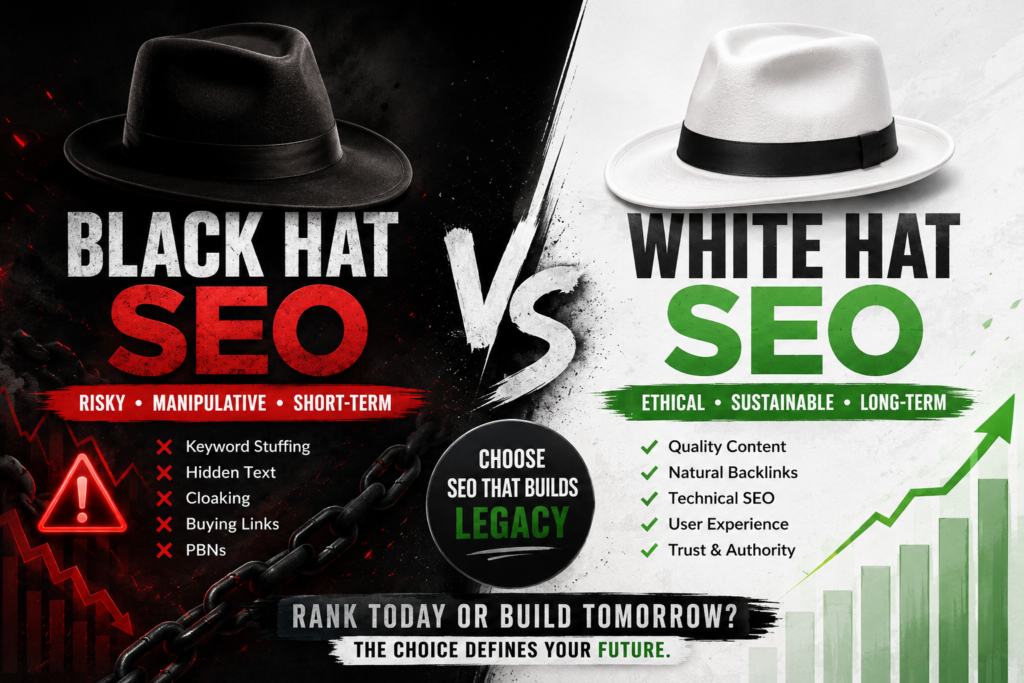
BLACK
HAT
VS
WHITE
HAT SEO
The complete, no-filter comparison — every tactic, every risk, every penalty. What works, what destroys rankings, and the only approach worth building your business on in 2026. By Media Mosiac.
Why This Comparison Matters in 2026
Every business owner investing in SEO eventually faces this question: should I play by Google's rules, or are there shortcuts that get results faster? The "black hat vs white hat SEO" debate has existed since search engines launched, but in 2026, the stakes have never been higher — and the answer has never been clearer.
Google's AI-powered algorithms — Penguin, Panda, Helpful Content, SpamBrain — have become extraordinarily sophisticated at detecting manipulative tactics. At the same time, a single algorithmic update or manual review can wipe out years of black hat gains overnight. The businesses that ignored this reality have paid an enormous price.
At Media Mosiac, our SEO team has worked with hundreds of businesses — including many who came to us after losing rankings to Google penalties. This guide gives you the complete, unvarnished truth about both approaches so you can make an informed decision about your SEO strategy.
The Core Tension: Black hat SEO promises rankings fast. White hat SEO promises rankings that last. For any business building genuine long-term value, the choice should be obvious — but the temptation of shortcuts is real, and understanding exactly why they're dangerous helps you resist them and make the right investment in your SEO strategy.
Defining Black Hat & White Hat SEO
The terminology comes from classic Western films — black hats were worn by villains, white hats by heroes. In SEO, the same moral divide applies:
Black Hat SEO
Techniques that deliberately violate Google's Webmaster Guidelines to artificially manipulate search rankings. These tactics exploit loopholes in the algorithm rather than genuinely earning ranking through quality and relevance.
White Hat SEO
Techniques that fully comply with Google's Webmaster Guidelines, focused on genuinely earning rankings through valuable content, excellent user experience, and legitimate authority building. Built to last — algorithm-proof by design.
The Third Category: Between black and white sits "grey hat SEO" — techniques not explicitly prohibited but not fully aligned with best practices. Examples include buying expired domains, aggressive anchor text ratios, and parasite SEO. Grey hat is covered in its own section later. For most businesses, grey hat carries unjustifiable risk.
Black Hat SEO Tactics — All Explained
Here is every major black hat SEO tactic, how it works, and exactly why Google penalises it. Understanding these protects you from two things: doing them yourself, and being victimised by agencies that secretly use them on your behalf.
Cramming target keywords into content at an unnatural density — repeating "best SEO agency Delhi" 40 times on a single page. Also includes stuffing keywords into hidden text, meta tags, or invisible divs. Google detects unnatural keyword density and penalises pages that appear to be written for search bots rather than humans.
🚨 Critical Risk — Algorithmic PenaltyPaying for backlinks from low-quality websites, link farms, or link exchanges — manipulating PageRank in violation of Google's link scheme policy. Covered by Google's Penguin algorithm since 2012. In 2026, Google's SpamBrain AI identifies paid link patterns with near-perfect accuracy. Consequences: manual penalty (Google Webmaster message) or algorithmic devaluation.
🚨 Critical Risk — Manual Penalty + DeindexationShowing one version of a page to Google's crawlers and a completely different version to human visitors. For example, a page showing keyword-rich text to Googlebot but actual content to users. Google's rendering systems now execute JavaScript, match user-agent strings, and compare rendered vs crawled content — making modern cloaking detection highly reliable.
🚨 Critical Risk — Immediate Manual ActionBuilding or buying a network of websites solely to link back to a "money site" — manufacturing authority from sites you control rather than earning it. PBNs are detectable through shared hosting patterns, registration data, IP proximity, content overlap, and link velocity patterns. Google's algorithm devalues known PBN links; manual action deindexes both the PBN sites and the money site.
🚨 Critical Risk — Site DeindexationMaking text or links invisible to users by using white text on white backgrounds, CSS position off-screen, display:none, or zero font size — but still readable by search bots. One of the oldest black hat tactics and one of the most reliably penalised. Google's Panda and SpamBrain algorithms identify this pattern with very high accuracy in 2026.
🚨 Critical Risk — Panda PenaltyCreating large numbers of near-identical pages targeting slight keyword variations (e.g., "plumber Sydney", "plumber Sydney NSW", "Sydney plumber") that all redirect to one page, or thin pages designed solely to rank for specific terms without offering genuine user value. Distinct from legitimate location pages, which have unique, genuinely useful content for each location.
⚠️ High Risk — Manual PenaltyPublishing thousands of low-quality, AI-generated articles designed purely for search rankings with no genuine user value. Post-2023 Helpful Content updates, Google explicitly targets "mass-produced content" that demonstrates no original expertise, experience, authoritativeness, or trustworthiness (E-E-A-T). Sites relying on this saw rankings collapse 60–90% in the September 2023 and 2024 HCU updates.
🚨 Critical Risk — HCU DemotionBuying Google reviews, using review exchange schemes, or having employees/friends mass-post fake reviews. Google's review quality algorithms detect inauthentic patterns including geographic anomalies, account age, review velocity, and linguistic patterns. Beyond SEO risk, this also violates consumer protection laws in many jurisdictions.
🚨 Critical Risk — GBP Suspension + Legal RiskDeliberately building toxic, spammy backlinks to a competitor's website to trigger a Google penalty against them. While technically a black hat tactic aimed at others rather than yourself, using this approach exposes you to severe ethical, legal, and reputational risks — and Google's Disavow tool makes many such attacks ineffective.
🚨 Critical Risk — Legal LiabilityAdding fake or misleading structured data — showing fake star ratings, false event dates, or false product information in rich snippets to attract clicks. Google's Rich Results manual review team actively monitors and penalises manipulative schema with rich snippet removal and manual actions.
⚠️ High Risk — Rich Snippet RemovalGoogle Penalties — What Really Happens
Google issues penalties in two ways: algorithmic (automatic, system-triggered) and manual actions (triggered by a human reviewer at Google). Both can be devastating. Here are real penalty scenarios service businesses face:
Triggered by unnatural link profiles — too many exact-match anchor text links, link farm backlinks, or sudden link velocity spikes. Impact: Rankings drop 40–100% across all keywords simultaneously. Recovery: Disavow toxic links in Google Search Console + earn natural links. Timeline: 3–12 months to recover. Sometimes rankings never fully return to pre-penalty levels.
Triggered by sites with high proportions of low-value, AI-generated, or thin content that doesn't demonstrate genuine expertise. Impact: Broad sitewide ranking demotion — even high-quality pages on the same domain are dragged down. Recovery: Remove or substantially improve affected content + demonstrate genuine E-E-A-T signals. Timeline: 6–18 months minimum.
Issued by a Google Search Quality Reviewer when they identify clear link scheme violations. Impact: Notification in Google Search Console + partial or full deindexation. Recovery: Disavow toxic links + submit reconsideration request with a detailed explanation of what was done and why it won't happen again. Success rate: approximately 50–60%. Timeline: weeks to months per review cycle.
One of the most severe manual actions. Impact: Complete deindexation of the affected site — it disappears entirely from Google search results. Recovery: Fix the cloaking issue + submit detailed reconsideration request. Recovery is possible but takes months and requires extensive documentation. Some sites never fully recover their historical rankings.
"There are no shortcuts to sustainable SEO. A penalty that takes 3 days to earn can take 3 years to recover from — if recovery is possible at all. Every client who has come to us after a penalty has confirmed the same thing: the short-term gains were never worth the catastrophic long-term cost."
— Media Mosiac SEO TeamWhite Hat SEO Strategies That Actually Work
White hat SEO is not just "safe SEO" — it's the only SEO that builds compounding, durable, algorithm-proof rankings over time. Here are the strategies our team at Media Mosiac implements across every client campaign:
Creating comprehensive, genuinely expert content that demonstrates Experience, Expertise, Authoritativeness, and Trust — Google's 2026 gold standard. This means content written by real subject-matter experts, citing credible sources, providing original insights, and genuinely answering user queries better than any competing page.
✅ Zero Penalty Risk — Ranking AssetEnsuring Google can efficiently crawl and index your site — fixing broken links, optimising site architecture, implementing proper canonical tags, managing crawl budget, improving Core Web Vitals (LCP, INP, CLS), implementing HTTPS, creating XML sitemaps, and using structured data correctly. This is the invisible foundation every ranking depends on.
✅ Zero Penalty Risk — FoundationalEarning backlinks naturally through digital PR campaigns, data journalism, expert commentary for publications, and creating genuinely link-worthy resources (tools, research, infographics, definitive guides). These editorial links from authoritative domains are the most valuable ranking signals in Google's algorithm and completely penalty-proof.
✅ Zero Penalty Risk — Highest AuthorityOptimising Google Business Profile, building consistent NAP citations, earning genuine customer reviews, creating location-specific content pages, and implementing LocalBusiness schema. This is the dominant strategy for service businesses targeting local customers and drives leads with zero paid media cost once established.
✅ Zero Penalty Risk — Local DominantOptimising Largest Contentful Paint (LCP under 2.5s), Interaction to Next Paint (INP under 200ms), and Cumulative Layout Shift (CLS under 0.1) — Google's Page Experience signals that directly impact rankings. Mobile speed, HTTPS, and absence of intrusive interstitials are additional experience factors weighted in 2026's algorithm.
✅ Zero Penalty Risk — Ranking FactorWriting genuine, expert articles for reputable industry publications in exchange for an author bio link. Distinguished from paid link schemes by: the content is real editorial value, the publication is credible and editorial in nature, and the link is contextual and natural. This builds both backlink authority and brand credibility simultaneously. Our SEO team manages quality guest posting outreach for clients.
✅ Zero Penalty Risk — Authority BuilderThe White Hat SEO Compound Growth Timeline
Fix all technical SEO issues, ensure proper crawlability, improve Core Web Vitals, set up Google Search Console, install analytics, and establish keyword research. Results may not be visible yet, but this work determines everything that follows.
Publish service pages, location pages, and blog content targeting high-priority keywords. Google begins indexing new content, initial impressions appear in Search Console, and some long-tail keywords start appearing in position 20–50.
Long-tail keywords move into top 10–20. Initial organic traffic appears. First leads from organic search. Link building campaigns begin showing in backlink profiles. This is the stage where many businesses give up too early — just before results compound.
Primary keywords reach Page 1–2. Organic traffic grows 200–400% from baseline. Leads from SEO become a consistent, predictable channel. Blog content earns natural backlinks. ROI turns significantly positive.
Multiple Page 1 rankings for competitive primary keywords. Organic traffic is the business's most reliable lead source. Zero cost per lead. Algorithm-proof — individual Google updates affect black hat sites; the white hat site maintains or improves rankings through each update cycle.
Grey Hat SEO — The Dangerous Middle Ground
Grey hat SEO sits in the uncertain territory between clear violations and best practices. These tactics aren't explicitly listed in Google's guidelines as prohibited, but they contradict the spirit of those guidelines and carry genuine penalty risk.
- Buying Expired Domains: Acquiring expired domains with existing authority and redirecting them to your site. Not explicitly banned, but Google has stated it devalues "domain authority laundering." Risk increases with scale and lack of topical relevance.
- Parasite SEO: Publishing content on high-authority third-party platforms (Medium, LinkedIn Articles, Reddit) to rank for competitive terms and funnel traffic to your site. Works in short term but platforms increasingly restrict this practice.
- Aggressive Anchor Text Optimisation: Carefully engineering your backlink anchor text ratio just below the threshold that triggers algorithmic penalties. Risky because Google's threshold detection evolves with each update.
- Tiered Link Building: Building links to your backlinks (links-to-links) rather than directly to your site. Designed to amplify link power while keeping spammy links one step removed from your domain. Increasingly detected by Google's graph analysis.
- Strategic Content Spinning: Rewriting competitor content substantially enough to avoid duplication detection while requiring minimal original effort. Technically avoids thin content penalties if done well, but produces no genuine E-E-A-T value.
Media Mosiac's Position on Grey Hat: We don't use grey hat tactics for any client. The risk-reward ratio doesn't justify it. Google's algorithms become more sophisticated with every update cycle — what's grey hat today often becomes black hat in the next update. Building your SEO strategy on tactics that might become penalised in 6 months is not a strategy; it's gambling with your business's visibility.
Full Comparison Table
| Factor | ⚫ Black Hat SEO | ⚪ White Hat SEO | ◑ Grey Hat SEO |
|---|---|---|---|
| Speed of Results | Fast (days–weeks) | Slow (months) | Medium (weeks–months) |
| Longevity | Short (easily wiped) | Long (compounds forever) | Medium (update-dependent) |
| Google Penalty Risk | Critical | None | Moderate |
| Algorithm-Proof? | No — gets worse each update | Yes — improves with updates | No — grey becomes black |
| ROI (Long-Term) | Negative (after penalty) | Highest of any channel | Variable, declining |
| Initial Cost | Low to Medium | Medium to High | Low to Medium |
| Ongoing Cost | Constant (needs feeding) | Declining (compounds) | Moderate (risky maintenance) |
| Brand Safety | Serious risk | Completely safe | Moderate risk |
| Recovery from Loss | Difficult, 6–18+ months | N/A — not applicable | Difficult, unpredictable |
| Scalability | Limited — breaks at scale | Infinite — compounds | Limited |
| Best For | No responsible use case | All serious businesses | Experimental, not recommended |
| Media Mosiac Recommendation | Never Use | Always Use | Avoid |
Does Black Hat SEO Still Work in 2026?
This is the honest question that demands an honest answer. The truth is: yes, some black hat tactics still produce ranking gains in 2026 — in specific contexts, for limited periods. Keyword stuffing still works on very low-competition terms. PBNs still boost rankings in some niches. Buying links can temporarily improve DA scores.
But "still works" and "worth doing" are entirely different things. Here's the full picture:
- Short windows, shrinking returns: Black hat tactics that once held rankings for years now hold them for months. Google's update frequency has accelerated — major algorithmic refreshes happen multiple times per year.
- SpamBrain has changed the game: Google's AI spam detection system processes billions of pages constantly. It identifies patterns, not just individual violations — making entire "categories" of manipulation detectable simultaneously across the web.
- Manual action teams are larger: Google has significantly expanded its Search Quality Reviewer team. Reports through Google's spam report tool are processed faster than ever.
- The competitive landscape has shifted: In most niches, the sites you're competing against have been building white hat authority for years. Temporary black hat gains rarely overcome the compounded authority of legitimate long-term SEO.
- The penalty is increasingly permanent: Several post-2023 HCU-penalised sites have not recovered after 18+ months despite extensive remediation. The collateral damage from black hat tactics is increasingly not reversible.
The Real Risk Calculation: A black hat campaign might generate 6 months of higher rankings. A manual penalty that follows could remove your site from Google for 12–24 months. If your business generates even ₹1 lakh/month from organic search, a 12-month deindexation costs you ₹12 lakhs minimum — plus the cost of recovery. The maths never works in black hat's favour.
The Verdict — Which Should You Choose?
After examining every tactic, every penalty, and every ROI calculation — here is Media Mosiac's definitive position:
Black Hat SEO
No legitimate business purpose justifies the risk. Short-term gains are smaller and shorter-lived than ever. Penalties are more severe and more permanent. There is no context in which we recommend black hat SEO to any client.
Our Verdict: Never Use
Grey Hat SEO
Unjustifiable risk-reward ratio for most businesses. Tactics that are "not explicitly banned today" become explicitly banned in the next algorithm update. Building a strategy on shifting ground is not a strategy.
Our Verdict: Avoid
White Hat SEO
The only approach that builds lasting, compounding, penalty-proof rankings. Slower to start, but the ROI compounds over time and the investment is never destroyed by a Google update.
Our Verdict: Always Use
If you're currently working with an SEO agency and are unsure whether they're using black or grey hat tactics on your behalf, ask them specifically: "Do you buy links? Do you use PBNs? Do you publish AI-generated content at scale?" Any hesitation or defensive response is a red flag. A reputable agency like Media Mosiac will answer these questions directly and transparently. Our SEO services are 100% white hat — we document every link we earn, every piece of content we create, and every optimisation we implement.
RANK HIGHER.
THE RIGHT WAY.
Media Mosiac builds penalty-proof, sustainable search rankings for businesses across India, UAE, and beyond. Every link earned. Every ranking deserved. Zero compromise.
Frequently Asked Questions
Conclusion
The black hat vs white hat SEO debate is, at its core, a debate between short-term thinking and long-term thinking. Between gambling with your business's most valuable digital asset and investing in it responsibly.
In 2026, Google's ability to detect and penalise manipulative tactics has never been more advanced. The window for black hat gains has never been shorter. And the permanent damage from penalties has never been more severe. There is no responsible argument for using black hat SEO to grow a legitimate business.
White hat SEO is slower — that's the honest truth. But it's also the only approach that compounds over time, survives every Google algorithm update, and builds an organic search presence that becomes more valuable every month you invest in it. The businesses that started proper white hat SEO 2 years ago are now generating leads at near-zero cost. The businesses that chased shortcuts are rebuilding from zero.
At Media Mosiac, every SEO campaign we run is 100% white hat — documented, transparent, and built to last. Our SEO services cover technical SEO, content strategy, local SEO, and ethical link building for service businesses across India, UAE, and globally. We also offer SEO-ready website development, Meta Ads management, and full performance marketing to complement your organic growth strategy. Contact us for a free SEO audit →
Media Mosiac is a performance-driven digital agency delivering 100% white hat SEO, website development, Meta Ads, and performance marketing for businesses across India, UAE, and globally. Our SEO team has managed 500+ campaigns, never using a single black hat tactic. Services: SEO · Web Dev · Meta Ads · Performance Marketing. About us →