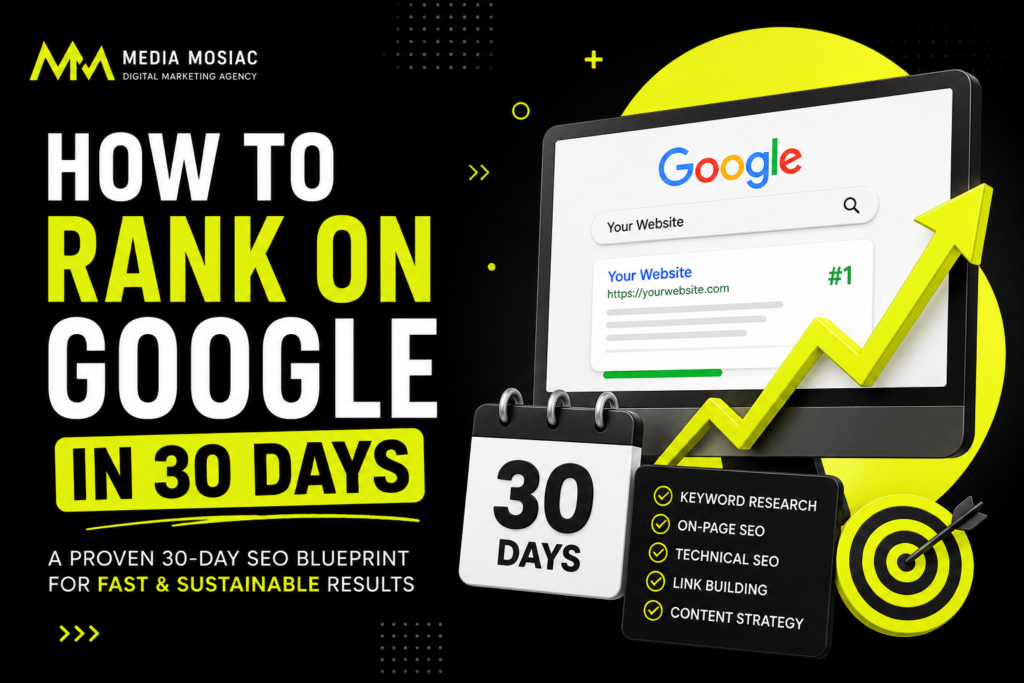
How to Rank on
Google in 30 Days
TL;DR: Ranking on Google in 30 days is possible — if you target low-competition keywords, write genuinely helpful content, nail your technical SEO, and earn at least a few quality backlinks. This guide gives you the exact playbook we use at Media Mosiac for our clients.
Is Ranking on Google in 30 Days Really Possible?
Let's be honest — there's a lot of misleading content out there promising "instant Google rankings." Here's the reality: for high-competition keywords like "digital marketing agency," you won't rank #1 in 30 days. Nobody will, and anyone who says otherwise is selling you a dream.
But here's what IS real: for long-tail, low-competition, high-intent keywords, ranking within 30 days is absolutely achievable — and it's exactly the strategy we use at Media Mosiac's SEO services to generate early wins for our clients.
The key is to shift your mindset. Instead of trying to rank for "SEO," try ranking for "affordable SEO services for small businesses in Srinagar." Volume is lower, but intent is laser-sharp — and these rankings convert.
Step 1 — Keyword Research That Wins Fast
Keyword research isn't about finding the most popular search terms. For a 30-day sprint, it's about finding winnable opportunities — keywords where the current top 10 results are weak, outdated, or irrelevant.
🎯 The 3-Filter Keyword Formula
- Low KD (Keyword Difficulty): Aim for keywords with a KD score below 30 on Ahrefs or Semrush. These are beatable even for newer pages.
- Search Volume 100–1,000/mo: High-volume terms are too competitive. Sweet spot is 100–1,000 monthly searches with commercial or informational intent.
- Long-tail (4+ words): "How to do SEO for a new website in 2025" beats "SEO tips" every single time for fast rankings.
- Clear user intent: Informational (how-to), Navigational (brand searches), Commercial (best X for Y), or Transactional (buy X). Match content type to intent.
Pro Tip from Media Mosiac
Use Google's "People Also Ask" and autocomplete suggestions as a free keyword goldmine. Every question that appears there is a real search query that's underserved in content. Build a blog post around it and you've already found your audience.
Step 2 — On-Page SEO Fundamentals
On-page SEO is the single highest-leverage activity you control 100%. Get this right, and Google will understand exactly what your page is about, who it serves, and why it deserves to rank.
Step 3 — Content That Google Loves in 2025
Google's Helpful Content Update changed everything. The algorithm now explicitly rewards content created for people — not for search engines. If you're stuffing keywords and providing shallow answers, you'll be penalized, not ranked.
Here's what "helpful content" actually means in practice:
- Answer the full question: Don't just answer what was asked — anticipate follow-up questions and answer those too. Think "topical depth."
- Show E-E-A-T: Experience, Expertise, Authoritativeness, Trustworthiness. Add author bios, cite sources, show real data and examples from your experience.
- Content length = what the topic needs: A local service page needs 600–800 words. A comprehensive guide like this needs 1,500–3,000. Don't pad, don't trim.
- LSI Keywords: Use semantically related terms naturally. If your topic is "SEO," also mention "search rankings," "organic traffic," "SERP," "backlinks" — Google understands context.
- Update content regularly: Google values freshness. Even updating a publish date with new stats can give stale content a ranking boost.
"The best SEO content doesn't try to rank. It tries to be the definitive answer to a question — and Google rewards it for that."
— Media Mosiac SEO TeamStep 4 — Technical SEO Checklist
Even the best content won't rank if Google can't crawl, understand, and index your site properly. Technical SEO is the foundation everything else is built on — and for WordPress sites, most of it can be fixed in a weekend.
- Core Web Vitals: LCP under 2.5s, FID under 100ms, CLS under 0.1. Use Google PageSpeed Insights to check. On WordPress, Perfmatters or WP Rocket helps enormously.
- XML Sitemap: Generate via Yoast or RankMath and submit to Google Search Console. This tells Google every page that exists on your site.
- HTTPS / SSL: Non-negotiable. Google explicitly uses HTTPS as a ranking signal. Install your SSL certificate if you haven't already.
- Mobile-First Design: Over 63% of Google searches happen on mobile. Use Google's Mobile-Friendly Test. WordPress: choose a responsive, lightweight theme.
- Schema Markup: Add structured data (Article, FAQ, How-To) to help Google understand your content and earn rich snippets in SERPs.
- Fix Broken Links: 404 errors waste crawl budget and hurt UX. Use Screaming Frog or Ahrefs' free broken link checker to audit your site monthly.
- Canonical Tags: Prevent duplicate content issues. Every page should have a self-referencing canonical tag (Yoast/RankMath handles this automatically).
WordPress-Specific Tip
Install RankMath SEO (free) for schema, sitemaps, and on-page optimization, WP Rocket for speed, and ShortPixel for image compression. These three plugins alone cover 80% of your technical SEO needs on WordPress.
Step 5 — Link Building in 30 Days
Backlinks remain one of Google's top 3 ranking factors. But in 30 days, you're not building a link empire — you're building enough relevant, quality signals to establish credibility for your target keyword.
🔗 Fast Link Building Tactics That Actually Work
- Guest Posts on Industry Blogs: Write one high-quality guest post for a relevant site in your niche. Even a DA 25–40 site is hugely valuable when you're starting out.
- Digital PR / HARO: Sign up for Help a Reporter Out (HARO). Journalists need expert quotes daily — one feature can earn you a backlink from a DA 70+ news site.
- Broken Link Building: Find relevant pages in your niche with broken outbound links. Offer your page as a replacement. Tools: Check My Links (Chrome extension) or Ahrefs.
- Niche Directories & Citations: Submit to relevant industry directories — these count as links and boost local/topical authority simultaneously.
- Social Signals: Share your content on LinkedIn, Twitter/X, and relevant Reddit communities. While social links are "nofollow," they drive real traffic that signals to Google that your content is valuable.
Need help with a professional SEO and link building strategy customized to your business? Our team at Media Mosiac handles the entire pipeline — from outreach to placement.
Your 30-Day Action Plan (Week by Week)
Here's the exact execution timeline we recommend. This is what separates people who talk about SEO and people who actually rank.
- Complete keyword research (10–15 target keywords)
- Audit technical SEO — fix crawl errors, submit sitemap
- Install RankMath/Yoast, configure settings
- Set up Google Search Console and Google Analytics 4
- Analyze top 3 competitors for your target keywords
- Write & publish 3 long-form blog posts (1,500–2,500 words each)
- Optimize existing pages — update title tags, meta descriptions, H-tags
- Add internal links between new and existing pages
- Create/optimize your Google Business Profile (for local SEO)
- Compress all images, add descriptive alt text
- Publish 2 more blog posts targeting secondary keywords
- Reach out to 5 sites for guest post opportunities
- Submit to 10–15 niche directories and local citations
- Share all new content across social media channels
- Respond to 3–5 HARO queries in your niche
- Check Google Search Console — which queries are gaining impressions?
- Update underperforming content (add more detail, better structure)
- Build 2–3 more backlinks from your guest post outreach
- Create a content calendar for the next 60 days
- Celebrate early wins — and double down on what's working 🎉
Top SEO Tools to Use
You don't need expensive tools to rank in 30 days. Here's the lean toolkit we recommend:
Frequently Asked Questions
Ranking on Google is not magic — it's a system. Keyword research + quality content + technical fundamentals + strategic link building = a page that earns its place on Page 1. The businesses winning in search in 2025 are the ones treating SEO as an ongoing investment, not a one-time task.
If you want to skip the learning curve and have a team of performance-driven SEO experts build and execute this strategy for you, explore Media Mosiac's SEO services — we've helped 500+ brands generate consistent organic growth across India, UAE, and Australia.
Ready to Rank?
Let Media Mosiac
Put You on Page One
500+ brands. ₹12Cr+ in managed ad spend. A team obsessed with measurable growth. Let's build your SEO engine.