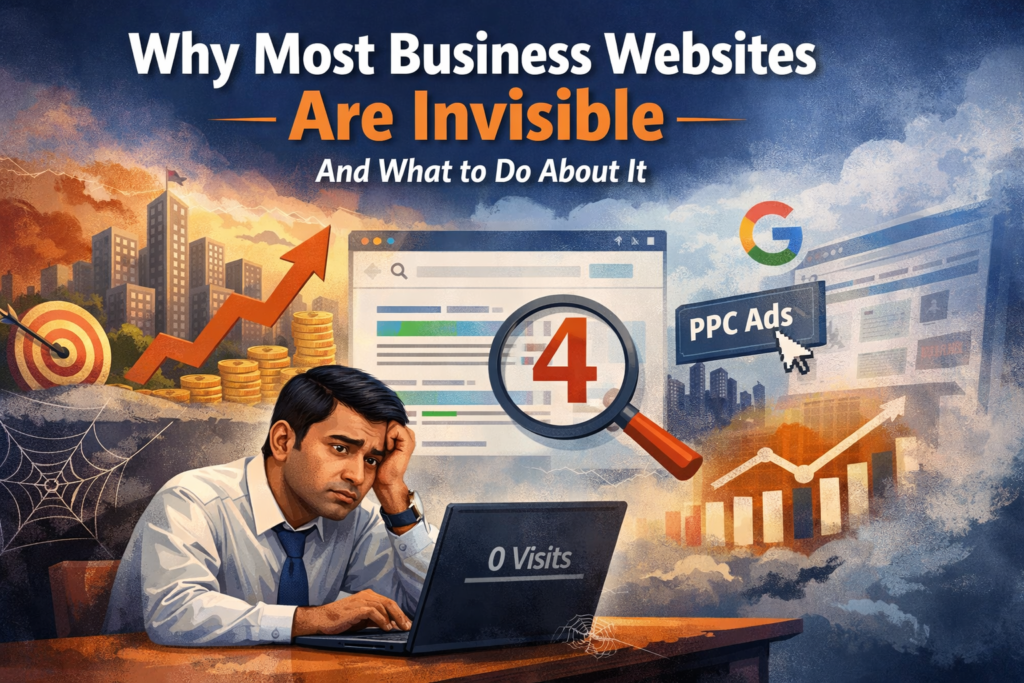
Why Most Business Websites Are Invisible — And What to Do About It
Your competitors are on Google's first page. You're on page four. Here's the honest conversation no one is having with you — and the roadmap to fix it.
Is Your Website Actually Working for You?
Discover why visibility — not design — is the real difference between a website that generates leads and one that collects digital dust.
Let me be direct with you. After years working in digital marketing, the single most common mistake I see business owners make is pouring money into a beautiful website that nobody ever finds. It's the digital equivalent of opening a shop in the middle of the desert and wondering why no customers walk through the door.
The internet is not a level playing field — and it never has been. Google's search algorithm determines, with extraordinary precision, which businesses deserve to be seen and which get buried. The good news? The rules are not secret. They are simply ignored by most business owners.
Sources: Backlinko, BrightEdge Research
The Visibility Problem Is Actually a Strategy Problem
Here is what happens over and over: a business invests ₹1–5 lakhs into a sleek, mobile-friendly website. Great design. Fast loading. Impressive animations. They publish it, share it on their WhatsApp status, and wait. Six months later, Google Analytics shows 83 visitors a month. Eighty-three.
That is not a website. That is an expensive digital business card collecting dust. The issue is almost never the website itself — the issue is that no coherent digital strategy exists around it. No SEO foundation. No content plan. No backlink structure. No local signals. The site was built to be beautiful, not to be found.
"A website without SEO is like a car without fuel. You can admire it all you want — it isn't going anywhere."
This is exactly the gap that a full-service digital partner fills. At Media Mosiac, we combine web development, SEO strategy, and social media marketing into a single, coherent growth system — because piecemeal solutions rarely move the needle.
What Google Actually Rewards in 2026
The digital landscape has shifted dramatically. Google's Helpful Content System, Core Updates, and the rise of AI-generated overviews have changed the rules entirely. Businesses winning search today are not gaming the system — they are doing something far less glamorous and far more effective: being genuinely useful.
Google's algorithm now evaluates websites through the lens of E-E-A-T — Experience, Expertise, Authoritativeness, and Trustworthiness. According to Moz's SEO guide, this framework determines whether your content deserves to rank above a competitor's. Here's what a real, working SEO strategy looks like:
- Technical SEO: Fast load times (Core Web Vitals), clean crawlability, schema markup, mobile-first indexing — the foundation everything else rests on
- Keyword-driven content: Pages that answer the real questions your customers are typing into Google — validated with keyword research, not guesswork
- Local SEO: Google Business Profile optimisation, consistent NAP citations (Name, Address, Phone), and genuine reviews — still massively underutilised by most businesses
- Backlink authority: Links from relevant, reputable domains in your industry — not directories from 2009, not purchased links, not link farms
- Conversion optimisation: Traffic means nothing if visitors bounce — UX, page structure, and calls-to-action determine whether clicks become customers
- Content consistency: Google rewards websites that publish valuable content regularly — a single great blog post is good; a system of them is transformative
SEO vs PPC: Which One Does Your Business Need?
Every week, a business owner asks me whether to invest in SEO or PPC (pay-per-click advertising). The answer depends entirely on where you are in your business journey. Here is a clear comparison:
| Factor | SEO (Organic) | PPC (Paid Ads) |
|---|---|---|
| Speed to results | 3–12 months | Instant (hours) |
| Long-term cost | Lower — compounds over time | Higher — stops when budget stops |
| Traffic sustainability | ✓ Continues without ongoing spend | ✗ Stops when ads stop |
| Trust & credibility | ✓ Organic results trusted more | Moderate — users know it's an ad |
| Best for | Long-term brand authority | Launches, promos, fast leads |
| Ideal strategy | Use both — PPC funds short-term while SEO builds long-term compounding growth | |
According to Semrush's analysis, businesses that integrate both SEO and PPC see 25% higher conversion rates than those running either channel in isolation. The smartest brands use paid campaigns to generate immediate revenue while SEO builds momentum in the background.
The Role of Social Media in Your Search Rankings
A common misconception: social media posts directly boost Google rankings. They don't — at least not directly. However, a strong social media presence creates a powerful flywheel effect:
How Social Media Supports SEO Indirectly
When your content gets shared on LinkedIn, Instagram, or Twitter/X, it reaches new audiences who may link back to your website — and those backlinks are one of Google's strongest ranking signals. Social content also drives direct traffic to your site, which improves engagement metrics that algorithms notice. According to HubSpot's marketing data, companies that blog and share on social get 55% more website visitors than those that don't.
The Honest Timeline: What to Expect and When
I will not promise overnight results. Anyone who does is either selling you something or fundamentally misunderstands how search engines work. Here is a realistic SEO timeline based on consistent, professional effort:
- Month 1–2: Technical audit, keyword research, on-page optimisation, Google Search Console setup, site structure improvements
- Month 3–4: First content ranking movements, increased crawl frequency, local search improvements visible
- Month 5–6: Measurable organic traffic growth, several keywords on page 1 or 2, backlink profile growing
- Month 7–12: Significant traffic increase, consistent lead generation from organic, compounding returns begin
- Year 2+: Domain authority solidified, content ranks passively, competitors struggle to catch up
"The best time to start SEO was a year ago. The second-best time is today — because your competitors are not waiting."
Ready to Stop Being Invisible Online?
Get a free digital audit from the Media Mosiac team. We'll show you exactly where your website stands, what's holding you back, and how to fix it.
Get Your Free Audit →Where to Start — A Practical Action Plan
If you recognise your own situation in this article, here is the most practical advice I can give: do not try to fix everything at once. Start with a proper audit. Understand what your site currently does well, where it is broken, and what your real keyword opportunities are. From a good audit, a prioritised roadmap emerges — and from that roadmap, real, measurable growth follows.
Read our related guides to go deeper:
- The Complete Local SEO Guide for Indian Businesses
- Google Ads vs Facebook Ads: Which Delivers Better ROI?
- Why Website Speed Directly Affects Your Google Rankings
- All Media Mosiac Digital Marketing Services
For further reading from trusted industry sources, we recommend Ahrefs' SEO Basics guide and Search Engine Journal's comprehensive SEO primer — both are regularly updated and authoritative.
Frequently Asked Questions About SEO & Digital Marketing
SEO (Search Engine Optimisation) earns you organic rankings over time — it is a long-term investment that compounds. PPC (Pay-Per-Click) delivers instant visibility by paying for each click to your site. SEO generally has better ROI long-term; PPC is ideal for immediate traffic, seasonal promotions, or testing new offers. The most effective strategy combines both. Explore our PPC management services to see how we integrate them.
Social media does not directly affect Google rankings, but it amplifies your content's reach, drives referral traffic, and can generate backlinks — all of which support SEO indirectly. A coordinated strategy combining SEO, social media, and content marketing consistently yields better results than any single channel alone.
SEO pricing in India varies widely — freelancers may charge ₹8,000–₹25,000/month while full-service agencies typically range from ₹20,000–₹80,000+/month depending on scope, competition, and goals. The key metric is ROI: quality SEO that generates consistent inbound leads should pay for itself many times over within 12 months. Contact us for a custom quote based on your specific business needs.
Local SEO optimises your online presence for location-based searches like "digital marketing agency near me" or "best web developer in [city]". If your business serves customers in specific geographic areas, local SEO is one of the highest-ROI digital investments available — especially optimising your Google Business Profile, earning local reviews, and building citations.
Basic on-page SEO and content creation can absolutely be done in-house with training and the right tools like Ahrefs or Semrush. However, technical SEO, competitive link building, and advanced keyword strategy benefit significantly from professional expertise. Many businesses perform best with a hybrid model: in-house content supported by an agency for the technical and off-page heavy lifting. Talk to our team about what the right balance looks like for you.
The Media Mosiac team specialises in SEO, PPC, social media marketing, and web development for businesses that want real, measurable growth. Based in India, serving clients globally. Learn more about us →